
What it is
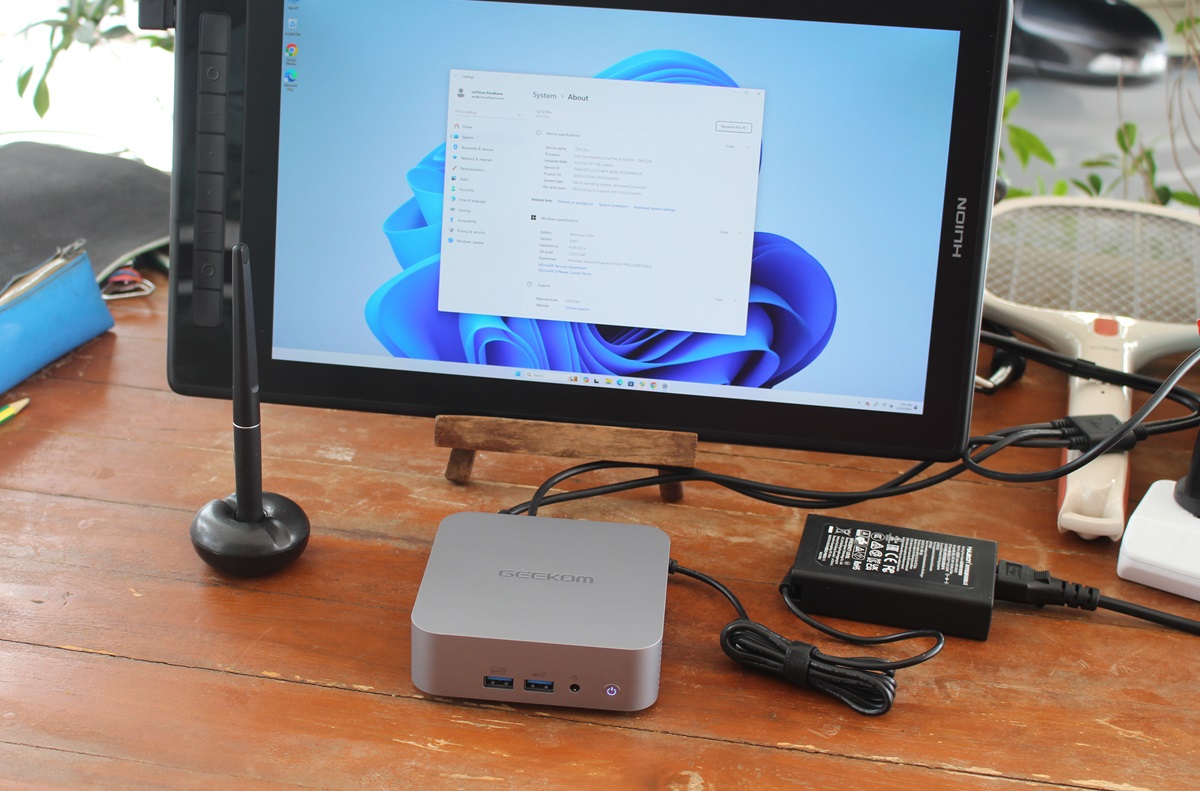
The Geekom GT13 Pro is the smallest mini PC in Geekom’s catalog that still ships with a top-tier 13th-gen Intel mobile chip. The case is one piece of milled aluminum: no visible joints, a brushed grey finish, the Geekom wordmark in metallic silver on the lid. Inside is either an Intel Core i9-13900H (6P + 8E, 20 threads, up to 5.4 GHz) or, on later SKUs, the unlocked i9-13900HK. There is also an i7-13620H variant for buyers who want the chassis at a lower price.
At 112 × 112 × 38 mm and roughly 450 grams, this is a 0.6-liter machine running a 45–65 W chip. The thermal story is the entire reason to read this review.
What it’s good for
Home and office work. Light productivity loads disappear into the Raptor Lake silicon. Office, Slack, Teams, two dozen Chrome tabs, a Zoom call, a 1080p video player: no compromise. NotebookCheck specifically called it a “stylish NUC alternative” for its target market.
Light creator work. Iris Xe at 96 EUs is not a discrete GPU, but Lightroom, Photoshop, and Premiere at 1080p are all in scope. Intel’s quick-sync hardware encoder is genuinely useful for streaming and lightweight 4K transcoding. CNX Software’s review benchmarked AV1 hardware decode working cleanly.
Coding and dev workstations. Two SO-DIMM slots at DDR4-3200 take up to 64 GB. A 14-core CPU with 20 threads compiles large projects fast for a 0.6 L machine. Ubuntu 24.04 ran without issue in the CNX Software review: Wi-Fi, Ethernet, and graphics all worked out of the box.
What it is not. This is not a gaming machine. Iris Xe will run esports titles at 1080p Low and modern AAA games only at sub-720p settings. If gaming is the priority, look at the AMD Radeon 780M-equipped Geekom A8 Max instead.
Build and connectivity
The single-piece aluminum chassis is the GT13 Pro’s calling card. There are no visible seams on the sides or top. The unit comes apart from the bottom, accessed by removing four rubber feet. Inside, the cooling stack is Geekom’s “IceBlast 1.5” design: a single blower fan and a copper heat-pipe array.
Port layout for a 0.6 L machine is generous:
- USB4 (40 Gbps) ×2, both rear, supporting Power Delivery and 8K display out
- HDMI 2.0 ×2
- USB 3.2 Gen2 Type-A ×3 (10 Gbps), USB 2.0 Type-A ×1
- 2.5 GbE Ethernet ×1 (Intel I226-V)
- 3.5 mm combo jack, SD card reader
Wi-Fi 6E + Bluetooth 5.2 on Intel’s AX211 module, proven and stable in the field.
Memory, storage, and thermals
DDR4 instead of DDR5 is the cost lever. Geekom uses two DDR4-3200 SO-DIMM slots up to 64 GB total. Memory bandwidth is meaningfully lower than DDR5-equipped peers, but for the workloads the GT13 Pro is built for (productivity, light creator, dev), the gap rarely matters in real-world feel.
Storage is one M.2 2280 PCIe Gen4 ×4 slot, supporting NVMe SSDs up to 2 TB.
Thermals are the catch. NotebookCheck’s testing found the i9-13900H sustaining only 35 W under prolonged load in this chassis, meaningfully below the chip’s typical 45 W envelope, and producing 20–30% lower multi-thread scores than the same CPU in larger machines. For burst workloads (compile, encode, lightroom export) the GT13 Pro is fine. For a 30-minute Cinebench-style sustained load, expect throttling. Related: how reviewers judged the Core i9 thermals in the Geekom IT13.
Pricing and where to buy
As of April 2026, the GT13 Pro lands as follows:
- i7-13620H, 32 GB / 1 TB: ~$549 on Amazon, ~$649 on geekom.com
- i9-13900H, 32 GB / 2 TB: ~$699–$799 on Amazon, with $100-off promo codes routinely available
- i9-13900HK, 32 GB / 1 TB: ~$899 on Amazon
The 3-year limited warranty applies to all retail paths. Amazon’s 30-day return window is the practical default.
What we’d flag
This is a fair review of a generally strong machine, but the trade-offs are real.
- Sustained thermals throttle the i9. A 14-core 13900H in a 0.6 L chassis will lose 20–30% on long benchmarks vs. larger Raptor Lake mini PCs. If you need sustained multi-thread throughput, the IT13 Max in a slightly larger 0.9 L case (or any 1.5 L+ NUC successor) will outrun it.
- DDR4, not DDR5. Cheaper and easier to upgrade, but a real bandwidth gap. A meaningful concern for memory-bound workloads (large database in-memory work, some scientific computing).
- Only one Ethernet port. The IT13 Max and A8 Max both ship dual 2.5 GbE; the GT13 Pro ships one. For a homelab box this is a meaningful downgrade.
- No headphone-out indicator LED on the front is a minor usability gripe across reviewer reports: easy to miss the audio jack in dim lighting.
Geekom GT13 Pro verdict
The Geekom GT13 Pro is what you buy when you want a 14-core Raptor Lake CPU in the smallest, most portable aluminum body Geekom currently offers. It is not the absolute fastest IT-series machine (the IT13 Max with Core Ultra 9 wins on raw silicon), but it is the prettiest, the lightest, and the cheapest path into the i9-13900H tier as of April 2026.
For a desk PC that hides behind a monitor, for a developer’s portable workstation, for an office machine that doesn’t look like an office machine, the GT13 Pro is a quietly tasteful choice.