
What the Geekom Air12 is
The Geekom Air12 is a budget mini PC built around Intel’s Processor N100, a four-core, four-thread Alder Lake-N chip with a 6-watt TDP and a 3.4 GHz boost. It is not a productivity workhorse. It is, intentionally, a low-power, low-noise, low-cost PC for the kinds of jobs that don’t need anything more.
Geekom’s pitch is straightforward: 16 GB of DDR5-4800 (in a real SO-DIMM slot, not soldered LPDDR), a 512 GB PCIe Gen3 NVMe SSD, two USB-C ports including one with DisplayPort Alt-Mode, Wi-Fi 6, and a 3-year warranty, all in a 117 × 112 × 34.2 mm chassis that runs under 35 dB even at full load. As of April 2026, the street price hovers around $284–$329 depending on configuration.
What it’s good for
Home office and light productivity. Office, web browsing, email, Teams calls: all of it works. CNX Software’s review noted the N100 handled twenty Firefox tabs and a Zoom call simultaneously without dropping frames. It is not a developer’s machine. It is, for the right person, a perfectly good general-purpose desktop.
HTPC and media playback. The N100’s iGPU includes hardware AV1, H.265, and VP9 decoders. 4K HDR playback from Plex, Jellyfin, or YouTube is smooth. Liliputing’s review specifically tested 4Kp60 and 8Kp60 YouTube streams. Both played without dropped frames.
Kiosk, classroom, signage. Quiet, low-power, small enough to VESA-mount behind a monitor. The Air12 disappears into a wall. Schools, hotels, retail signage: these are the natural use cases.
Light NAS or homelab controller. The single Gigabit Ethernet port limits storage throughput, but as a Pi-Hole / Home Assistant / Jellyfin host, the Air12 has more than enough CPU and far more RAM than a Raspberry Pi 5 at a comparable street price. CNX Software’s Ubuntu testing confirmed Linux compatibility is clean.
What it is not. The Air12 is not a gaming machine, a video editor, or an AI workstation. The four E-cores at 6 W will lose any direct comparison to a real laptop CPU. Don’t buy it expecting a Ryzen experience.
Build and connectivity
The Air12 chassis is a PC+ABS composite top over a full metal inner frame and base. It is not the all-aluminum construction of the A-series or IT-series, and at this price point that is the right call. CNX Software’s teardown found the inner frame rated to 440 lbs of pressure, enough that you could stack a monitor on it without anxiety.
Port layout is competent for the size:
- USB-C 3.2 Gen2 ×2 (one front, one rear; rear supports DisplayPort 1.4 Alt-Mode and 8K@30 Hz)
- USB-A 3.2 Gen2 ×3
- HDMI 2.0 ×1 (4K@60 Hz)
- Mini DisplayPort 1.4 ×1 (8K@30 Hz)
- Gigabit Ethernet ×1
- 3.5 mm combo jack, SD card reader, Kensington lock
Three-display support (HDMI + Mini DP + USB-C) is unusual at this price. Wi-Fi 6 and Bluetooth 5.2 round out connectivity.
Memory, storage, and the DDR5 detail
The Air12’s most under-rated feature is that the RAM is not soldered. Geekom uses a single DDR5-4800 SO-DIMM slot up to 32 GB. That alone separates the Air12 from most N100 competitors, which solder LPDDR5 at 8 or 16 GB and prevent any future upgrade.
Storage is a single M.2 2280 slot supporting PCIe Gen3 ×4 NVMe SSDs up to 2 TB. (Geekom also lists SATA M.2 compatibility for cheaper drives.) The base 512 GB SSD is OEM-grade but adequate for the workload class this machine targets.
Pricing and where to buy
As of April 2026, the Air12 SKUs land roughly:
- N100, 16 GB / 512 GB: ~$284–$299 on Amazon (with promo code GKES5)
- N150, 16 GB / 512 GB (“Air12 Lite”): ~$329, a slightly faster N-series chip
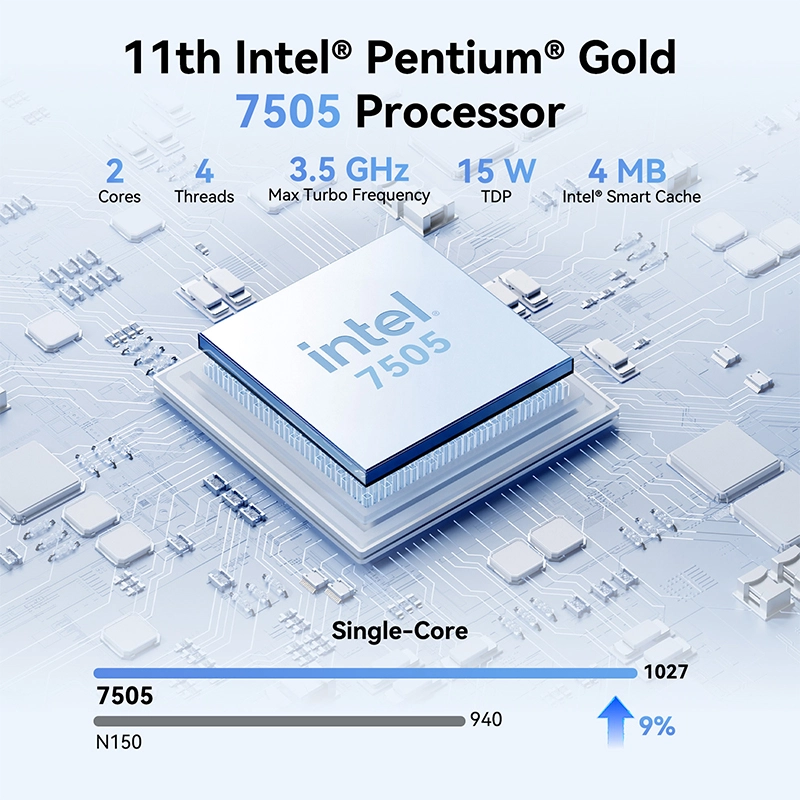
- Pentium Gold 7505, 16 GB / 512 GB: ~$329, an older Tiger Lake variant, not the recommended choice
Geekom’s own store sells the N100 config in the $299–$359 range. Amazon is faster to ship and has the cleaner 30-day return window. The 3-year warranty applies to both paths.
What we’d flag
- The Air12 is slow. The N100 is a 6 W chip with four E-cores. Single-thread performance is roughly half of a modern Ryzen 7 or Core Ultra 9. Multi-thread performance is much further behind. Buy this machine for what it is, not what you wish it were.
- Gigabit Ethernet, not 2.5 GbE. Cheap to fix with a USB-C adapter, but a real limitation if you intend the Air12 as a NAS host.
- Single SO-DIMM slot. 32 GB ceiling, not the 64 GB ceiling of the dual-SO-DIMM A6 or IT13 Max.
- PCIe Gen3, not Gen4. SSD throughput tops out around 3,500 MB/s sequential. Not a bottleneck for the Air12’s target workloads, but worth knowing.
- The chassis lid is plastic. Looks fine, feels less premium than the all-aluminum A6 or GT13 Pro. At this price point that is the trade-off.
Verdict
The Geekom Air12 is one of the most quietly sensible mini PCs of 2026. It does not pretend to be fast. It runs cool, runs quiet, ships with 16 GB of real upgradable DDR5, and lands consistently at or under $300. For a kid’s first computer, a parent’s email-and-browser machine, a kitchen HTPC, a Pi-Hole replacement, or a hotel-room signage box, it is genuinely hard to beat.
If you want more, buy more: the Geekom A6, the Geekom A8 Max, or the Geekom IT13 Max are all real upgrades. But if what you actually need is a small, quiet, cheap PC that just works, the Air12 is the right answer.