
What the Beelink SER9 HX 370 is
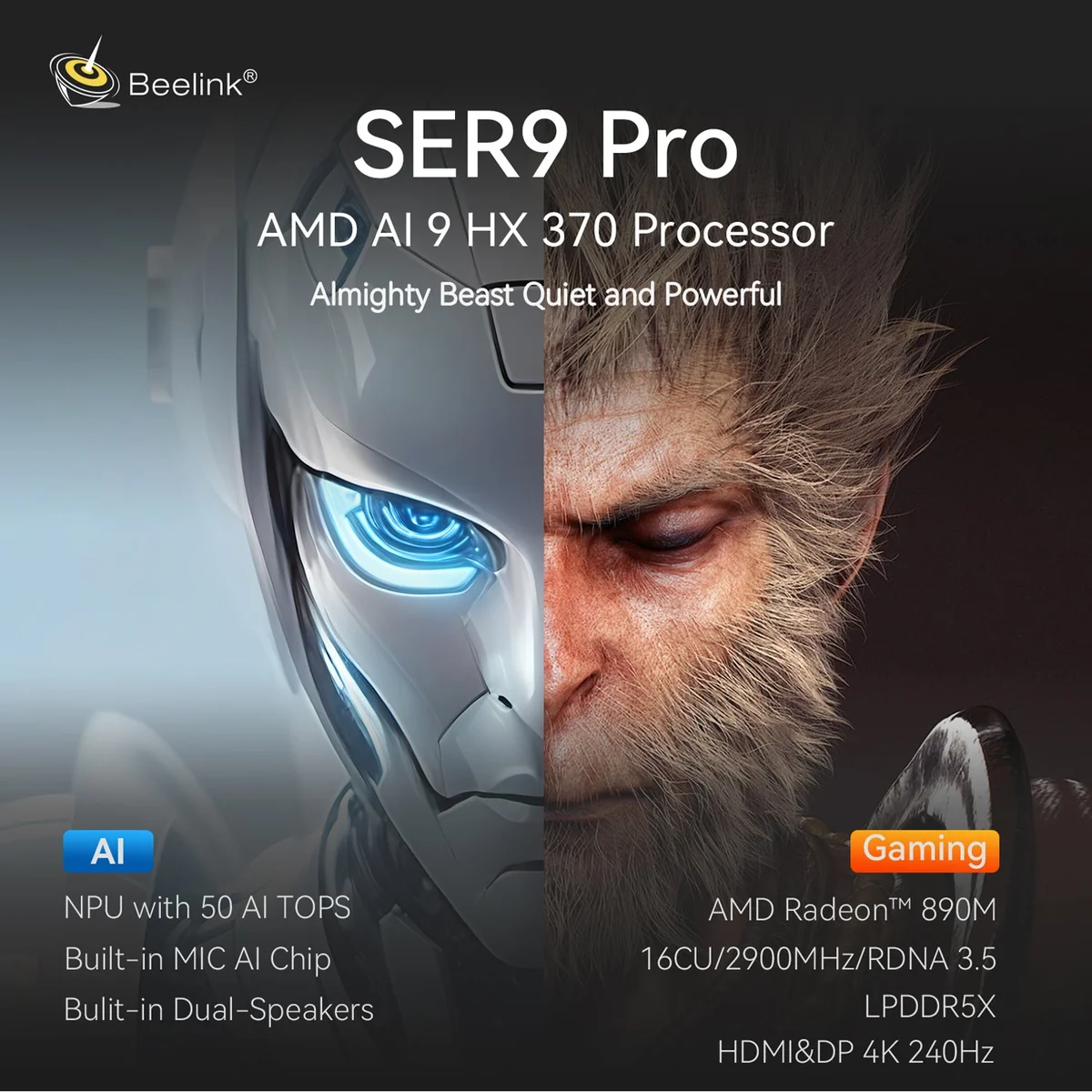
The Beelink SER9 is the first wave of Strix Point mini PCs to ship at scale. It pairs AMD’s Ryzen AI 9 HX 370 with 32 GB of LPDDR5X-7500 memory soldered to the board and a 1 TB Crucial PCIe 4.0 NVMe SSD. The HX 370 is a 12-core, 24-thread hybrid chip with four Zen 5 and eight Zen 5c cores, the Radeon 890M iGPU (16 RDNA 3.5 compute units at 2.9 GHz), and a dedicated XDNA 2 NPU rated at up to 50 AI TOPS.
It is a 65 W machine in a chassis you could stack between two paperbacks: aluminum on the visible faces, intake from the bottom, no vents on the top or side panels. The official Beelink store sells the 32 GB / 1 TB SKU at $1,149; Amazon’s US listing has lived in the $899–$999 band for most of 2026, periodically dropping under $900 on promotional days. That price-to-silicon ratio is the entire argument for this machine.
What it’s good for
Home and office work. A 12-core Zen 5 chip is overkill for tab juggling and Office, and that’s the point: it disappears under load. The SER9 keeps a productivity stack (browser with thirty tabs, Teams, Slack, Outlook, a VM running in the background) feeling indistinguishable from idle. With dual built-in speakers and a 360° far-field AI microphone array, it also doubles as a credible video-call endpoint without a USB headset.
On-device AI. The XDNA 2 NPU is the headline. At up to 50 TOPS on the NPU alone (and 80 TOPS combined across NPU, iGPU, and CPU), this comfortably clears the 40-TOPS bar Microsoft set for Copilot+ PC certification. For local LLM work, the Radeon 890M plus 32 GB of unified-ish LPDDR5X handles 7B–14B class models cleanly via Ollama or LM Studio with ROCm. It is not an RTX-class machine for 70B models, but for the day-to-day “AI PC” use case Microsoft and AMD have been pushing, this is one of the first mini PCs that actually delivers on the spec sheet.
1080p (and increasingly 1440p) gaming. The Radeon 890M is currently the fastest iGPU on the market. Most modern AAA titles hit 60+ fps at 1080p with a mix of medium and high settings, and FSR 3 Frame Generation pushes a lot of titles into the 90–120 fps range. Esports titles run well above 120 fps. ServeTheHome and NotebookCheck both saw the 890M sit roughly 30% ahead of the previous-generation Radeon 780M in the Ryzen 7 8845HS (the chip in the Beelink SER8), which lines up with what AMD claimed at launch.
Light creator workflows. Lightroom, Photoshop, Premiere at 1080p/4K proxy editing, and DaVinci Resolve for non-color-graded work all run comfortably. The dual M.2 2280 PCIe 4.0 slots are a real practical advantage here: you can drop a scratch disk in alongside the boot SSD without losing the OS install.
Build and connectivity
The SER9 is small (roughly 135 × 135 × 47 mm), full-metal on the visible surfaces, and tuned for quiet. Beelink rates sustained operation at roughly 32 dB, and most reviewers confirm the fan stays barely audible even under multi-core load. The 65 W TDP is real; the cooler is sized to actually feed it. The trade-off, well-documented by Hostbor and others, is that intake from the bottom means the unit needs an open surface. Sitting it on carpet or pressed against the back of a desk will choke airflow. Use the official stand or leave it on hard, open desk space.
Port layout is dense for the size:
- USB4 (40 Gbps, DP 1.4, TB3-compatible, PD) ×1: handles eGPUs, dual-4K docks, and 4K @ 240 Hz displays
- USB-A 3.2 ×4, USB-C ×1 (front)
- HDMI 2.1 ×1 (4K @ 120 Hz), DisplayPort 1.4 ×1 (4K @ 120 Hz)
- 2.5 GbE Ethernet ×1
- 3.5 mm combo jack, dual built-in speakers, built-in microphone array
Wireless is Wi-Fi 6 (Intel AX200) and Bluetooth 5.2. This is the one place a 2026 SKU at this price stings a little: Wi-Fi 7 is now standard on lower-tier units. The AX200 is rock-solid in practice, but it is a generation behind the spec sheet you might expect.
Memory, storage, and upgrades
The RAM is the most important caveat: LPDDR5X-7500 is soldered (4 × 8 GB) and not user-upgradable. You are committing to 32 GB for the life of the unit. For most of the SER9’s target use cases (gaming, creator, AI inference up to ~14B-parameter models), that is enough. For local 70B-class LLM work, virtualization at scale, or a multi-VM home lab, look at a Ryzen AI Max+ 395 unit (Beelink GTR9 Pro, GMKtec EVO-X2) with 64–128 GB instead.
Storage is the saving grace: two M.2 2280 PCIe 4.0 x4 slots, up to 8 TB combined, and the bundled 1 TB Crucial SSD is a genuine OEM-grade part rather than a no-name DRAM-less drive. Adding a second drive is a five-minute job with the included screwdriver.
Pricing and where to buy
As of May 2026, the 32 GB / 1 TB SER9 HX 370 lists at $1,149 on Beelink’s own store and consistently in the $899–$999 range on Amazon US. The Amazon listing carries the same 3-year warranty and ships from US fulfillment centers, which materially shortens RMA turnaround compared with the international ship-back-to-China path.
For comparison, the Minisforum AI X1 Pro with the same HX 370 chip lists at a similar nominal price, but Minisforum’s support track record (bricked BIOS updates, slow RMA timelines, contradictory warranty positions in the EU) makes the Beelink the safer commitment at this price point. Beelink offers lifetime technical support and a 3-year warranty, and reviewer experience with RMA escalation has been markedly more responsive.
What we’d flag
This is a positive review, but a fair one: the SER9 is not flawless.
- Soldered RAM, capped at 32 GB. No upgrade path. If your workload is RAM-bound, this is the wrong machine.
- Wi-Fi 6 (AX200), not Wi-Fi 7. Functionally fine, but spec-sheet behind for a $900–$1,150 unit in mid-2026.
- Bottom-intake cooling needs clearance. Don’t put it on carpet or against a soft surface. Hostbor specifically called this out as a real-world design constraint.
- No SD card reader. An unusual omission for a unit marketed at creators.
None of this is disqualifying. All of it is the cost of a 65 W Zen 5 chip in a 1-liter chassis.
Verdict
The Beelink SER9 HX 370 is the mini PC that finally makes the “AI PC” pitch concrete: Copilot+-class NPU performance, the fastest current-generation iGPU, a real 65 W cooler, and a sub-$1000 street price on Amazon US. The soldered 32 GB ceiling is the one architectural limitation that keeps it out of heavyweight local-LLM and home-lab territory, but inside its actual target envelope (home, office, creator, gaming, on-device AI), it delivers cleanly.
If you want Zen 5 and a serious iGPU in a sub-$1000 mini PC, and you want a brand whose support team actually answers tickets, this is the one to put on the short list. We recommend it.