
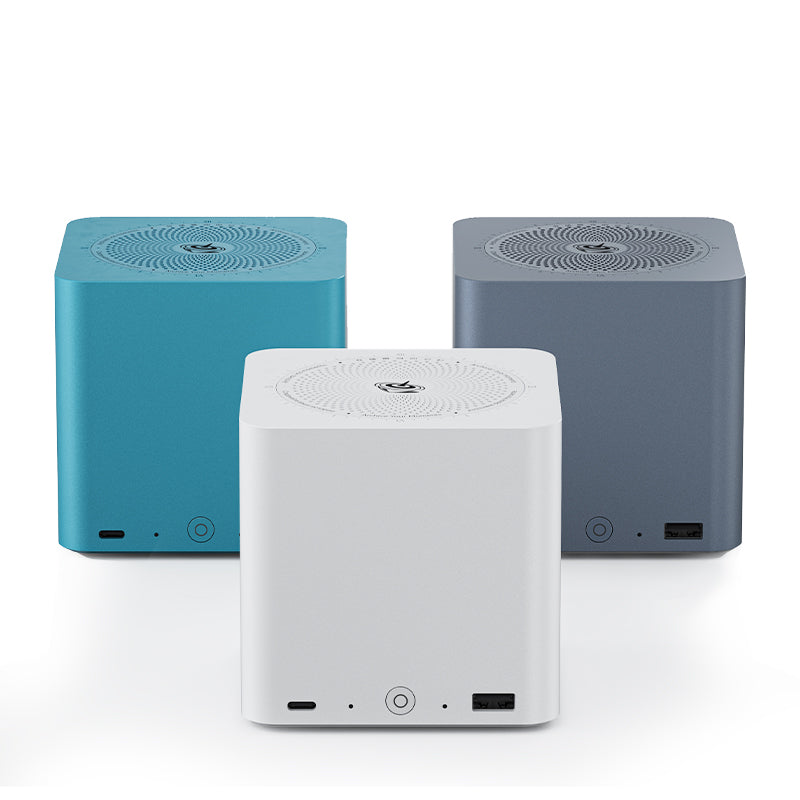
What the Beelink ME Mini is
The Beelink ME Mini is the company’s first dedicated NAS-class mini PC. It is a 99 millimeter cube (small enough to sit in the palm of one hand) with six M.2 2280 NVMe slots inside, a 64 GB eMMC drive soldered to the board for the OS, dual 2.5 GbE ports, and an Intel N150 SoC running the whole show. There is no spinning-disk option. There is no 3.5” bay. The ME Mini is an all-flash NAS, and that is the entire premise.
The form factor genuinely doesn’t exist anywhere else under $250. Synology, QNAP, and TerraMaster will sell you a four-bay all-SSD NAS, for two to three times the price, in twice the chassis volume. The trade Beelink is asking you to make is real: an N150 instead of an x86 NAS-class chip, a 45 W power budget across the whole platform, and 9 PCIe lanes split across six slots. That math is not generous. The product is still the most interesting NAS mini PC sold in 2026.
What it’s good for
All-flash home NAS. TrueNAS Scale, Unraid, OpenMediaVault, Synology DSM via Xpenology: all run cleanly on the N150 platform. With six 4 TB NVMe drives the unit caps at 24 TB raw, and the dual 2.5 GbE ports link-aggregate to a useful 5 Gbps for clients that support SMB Multichannel or LACP. For a household running Plex, Time Machine backups, photo sync, and bulk file storage, this is enough storage and enough network throughput.
Quiet home lab node. Six NVMe slots is unusual flexibility at this price. Even if you only populate three or four of them, the platform supports running ZFS mirrors or RAIDZ for resilience, while keeping the remaining slots empty for future expansion. Idle power sits around 8–10 W.
Plex / Jellyfin server. The N150’s Intel UHD iGPU handles 4K HEVC and AV1 hardware decode. Multiple simultaneous direct-play streams are well within scope. Transcoding multiple 4K streams concurrently is not. That’s a meaningfully more powerful CPU’s job.
Proxmox or Docker host. 12 GB of LPDDR5 and a 64 GB eMMC boot drive give you a workable platform for half a dozen containers or two or three lightweight VMs. It is not a 64-thread homelab server. It is a quiet, low-power container host.
This is not a NAS for video editors working off network shares. It is not a 10 GbE NAS. It is not a multi-user-with-heavy-transcoding NAS. The N150 platform is the limiter.
Build and connectivity
The 99 mm cube design is structural: the chassis is metal, with mesh on top and bottom for airflow, and the 8 cm fan runs at low RPM in normal operation. Reviewer reports converge on “near-silent” as long as you don’t pin all six SSDs writing simultaneously.
Ports are on the rear:
- 2.5 GbE Ethernet ×2 (Intel i226-V, both ports are managed independently)
- USB-A 3.2 Gen 2 ×2, USB-C 3.2 Gen 2 ×1
- HDMI 2.0 ×1
- 3.5 mm combo jack
- DC-in (45 W external PSU bundled)
Wi-Fi 6 and Bluetooth 5.2 are present but secondary. Anyone deploying this as a NAS will be on wired 2.5 GbE. Related: our report on Intel i226-V 2.5GbE instability.
Storage layout: the catch
This is the part of the spec sheet that needs to be read carefully.
The ME Mini has six M.2 2280 slots. They are not equal:
- Slot 4 (the system slot) is PCIe 3.0 x2, about 1,970 MB/s peak. This is where the OS-image drive lives by default if you replace the eMMC.
- Slots 1, 2, 3, 5, 6 are PCIe 3.0 x1, about 985 MB/s peak per drive.
The N150 platform exposes 9 PCIe Gen 3 lanes total. After 1 lane for the iGPU’s display path and 1 lane reserved for the Wi-Fi card, that’s 7 lanes left for storage and networking, and the 2.5 GbE controllers consume some of them. The result is the asymmetric layout above. It is the correct design choice given the platform constraints, and it is also a real ceiling on aggregate write performance when all six drives are active simultaneously.
For NAS workloads where reads are the dominant case and the network is the actual bottleneck (5 Gbps aggregate over dual 2.5 GbE), this is fine. For all-six-drives-writing-at-once benchmarks, the platform will not deliver.
Pricing and where to buy
The ME Mini ships with 12 GB LPDDR5, 64 GB eMMC, and 2 TB pre-installed in slot 4 at around $249–$299 on Amazon, and a barebones (no SSD installed) configuration runs around $209. Direct from Beelink the same configurations run a similar premium. Newegg occasionally lists the unit at the same price point with different bundle storage.
Warranty is one year through both retail paths. Related: Beelink Mini S13 review and the best mini PCs under $500.
What we’d flag
- The 45 W external PSU is barely enough. This is the single most-discussed flaw across reviewer testing. Six high-end NVMe drives can draw 4–7 W each at write peak, and the N150 platform itself draws up to 25 W under load. Multiple reviews recommend swapping the bundled brick for a 65–90 W replacement if you intend to populate all six slots.
- Soldered RAM, 12 GB ceiling. No SODIMM slot. This is a structural limit. ZFS deduplication is not in scope. ZFS without dedup, with reasonable ARC sizing, is fine.
- eMMC boot drive. 64 GB of soldered eMMC is OK for an OS image and not enough for any real workload. Most NAS deployments will install the OS to slot 4 and treat the eMMC as an emergency-recovery partition.
- PCIe 3.0 x1 on five of six slots. Architectural limit. Plan around it.
- No ECC RAM. This is a $209 mini PC, not a Synology DS1823+. If you need ECC, you are not the buyer.
- One-year warranty. Standard for the segment, short for a NAS that you’d reasonably expect to run 24/7 for five years.
Verdict
The Beelink ME Mini exists in a category of one. There is no other 99 mm cube that holds six M.2 NVMe drives, runs dual 2.5 GbE, and sells for $209 in 2026. The N150 is slow and the 45 W PSU is marginal, and both of those caveats are real. None of them disqualify the product.
If you want a quiet, all-flash, low-power home NAS that fits next to a router on a shelf and can hold up to 24 TB of solid-state storage, this is the unit. Replace the bundled PSU with something larger, install your OS to slot 4, and treat the platform’s PCIe constraints as the design they are. On those terms, the ME Mini is one of the more interesting NAS products of the year.