
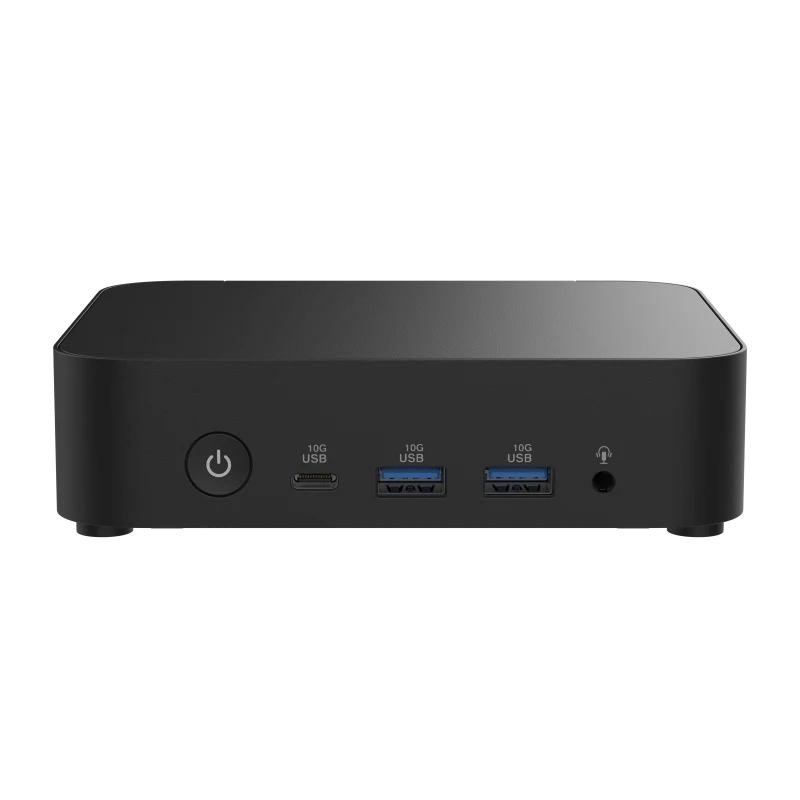
What the ASUS NUC 14 Essential is
The ASUS NUC 14 Essential is the entry point in the post-Intel ASUS NUC lineup: a 0.56-liter, half-pound mini PC built around Intel’s low-power N-series chips. The Alder Lake-N refresh family powers it: Intel Processor N100, N150, N250, with a Core i3-N355 at the top.
These are the chips that quietly displaced Celeron and Pentium across the entire low-end PC market. They are not exciting, and that is the point. With a 6-watt TDP and passive-leaning cooling, the N250 inside the NUC 14 Essential delivers four cores at up to 3.8 GHz Turbo while drawing less power at idle than the LED strip on a gaming PC.
What it’s good for
Home and small-office productivity. Web browsing, Microsoft 365, Google Workspace, Zoom, Teams, watching YouTube at 4K60: Hypertext and NotebookCheck both verified the N250 handles this comfortably. With 16 GB of DDR5 (the chassis maximum) and a fast NVMe SSD, the bottleneck for daily-driver use is almost never the CPU.
Digital signage and kiosks. Triple 4K display support and a 2.5 GbE port make this an obvious fit for retail signage, museum kiosks, and meeting-room display PCs. The 0.56-liter footprint slides behind any monitor on a VESA mount and disappears.
Classroom and computer-lab deployments. EPEAT Gold registration, ASUS’ commercial warranty channel, and the 6 W TDP (which translates to no fan noise in a quiet room) make this a credible school PC. A lab of thirty units consumes less power than a single gaming desktop.
HTPC duty. Triple display, hardware AV1 decode, Bluetooth 5.3 for remotes, Wi-Fi 6E. With Plex or Jellyfin and a 2 TB NVMe, the Essential is a perfectly capable living-room media PC.
Build and connectivity
The chassis is matte black, mostly plastic with a metal base, and at 470 g it is as close to “weightless” as a real PC gets. Build quality is meaningfully better than the no-name Chinese N100 boxes selling at the same price. Hypertext specifically called out the chassis as feeling “designed to last.”
Front panel:
- 1 × USB-C 10 Gbps
- 1 × USB-A 10 Gbps
- 3.5 mm combo audio
Rear panel:
- 2 × USB-A 10 Gbps
- 1 × USB 2.0
- 1 × USB-C with DisplayPort 1.4 (10 Gbps)
- 1 × DisplayPort 1.4
- 1 × HDMI 2.1
- 1 × 2.5 GbE Ethernet (Realtek)
Wireless is Intel Wi-Fi 6E AX211 with Bluetooth 5.3, the same module ASUS ships in the more expensive NUC 14 Pro.
Memory, storage, and upgrades
This is where the Essential’s positioning becomes clear: a single SO-DIMM slot, capped at 16 GB DDR5-4800, and a single M.2 2280 (or 2242) NVMe slot capable of accepting drives from 128 GB to 2 TB.
The single-slot RAM is the biggest constraint. If you outgrow 16 GB, your only path is buying a larger DIMM and replacing rather than supplementing. For the Essential’s actual workload (N250 with light productivity), 16 GB is generous. For anything past that, the NUC 14 Pro is the right SKU.
The bottom plate releases with two captive screws, both the DIMM slot and the M.2 are accessible from there, and ASUS includes a small screwdriver in the barebone box. Upgrade-friendliness is a step above what most cheap mini PCs deliver.
Pricing and where to buy
As of April 2026, Amazon lists the N250 barebone kit (no RAM, no SSD, no OS) at around $280–$310. The N150 variant runs $230–$250, and the full-system N250 / 16 GB / 256 GB / Windows 11 Pro lands at roughly $430.
ASUS’ own store and Newegg sell the same SKUs at small premiums. The barebone kit is the practical choice if you have spare DDR5-4800 SO-DIMMs and an NVMe drive in inventory; the full system is the right pick for a single-PC home buyer.
Related: for other Intel N-series boxes in this class, see our Beelink Mini S13 review and Geekom Air12 review.
What we’d flag
- Single-slot RAM, capped at 16 GB. This is the single biggest difference from the NUC 14 Pro. Buy with the workload you have, not the workload you might grow into.
- N-series silicon is not for power users. The N250 is roughly Pentium Silver-class. Photo editing in Lightroom is doable; video editing is not. Modern AAA gaming is not in scope at any resolution.
- PCIe 3.0 NVMe slot. The drive bay is Gen3 x4, not Gen4, capping NVMe sequential performance at around 3.5 GB/s. For this CPU class it is not a bottleneck, but it is a spec to know.
- Plastic chassis. Better than competitors at the price point, but not the all-metal premium feel of the NUC 14 Pro+.
Verdict
The ASUS NUC 14 Essential is the most polished Intel-N-series mini PC on the market right now. It’s not fast, it’s not exciting, and it doesn’t pretend to be. What it is is quiet, well-built, supportable through ASUS’ commercial channel, and meaningfully better than the $200 Chinese mini PCs it shares a price band with.
For digital signage, classrooms, kiosks, basic home offices, and HTPCs, this is the one we’d recommend. For anything more demanding, walk up the line to the NUC 14 Pro.