
What the AceMagic S1 is
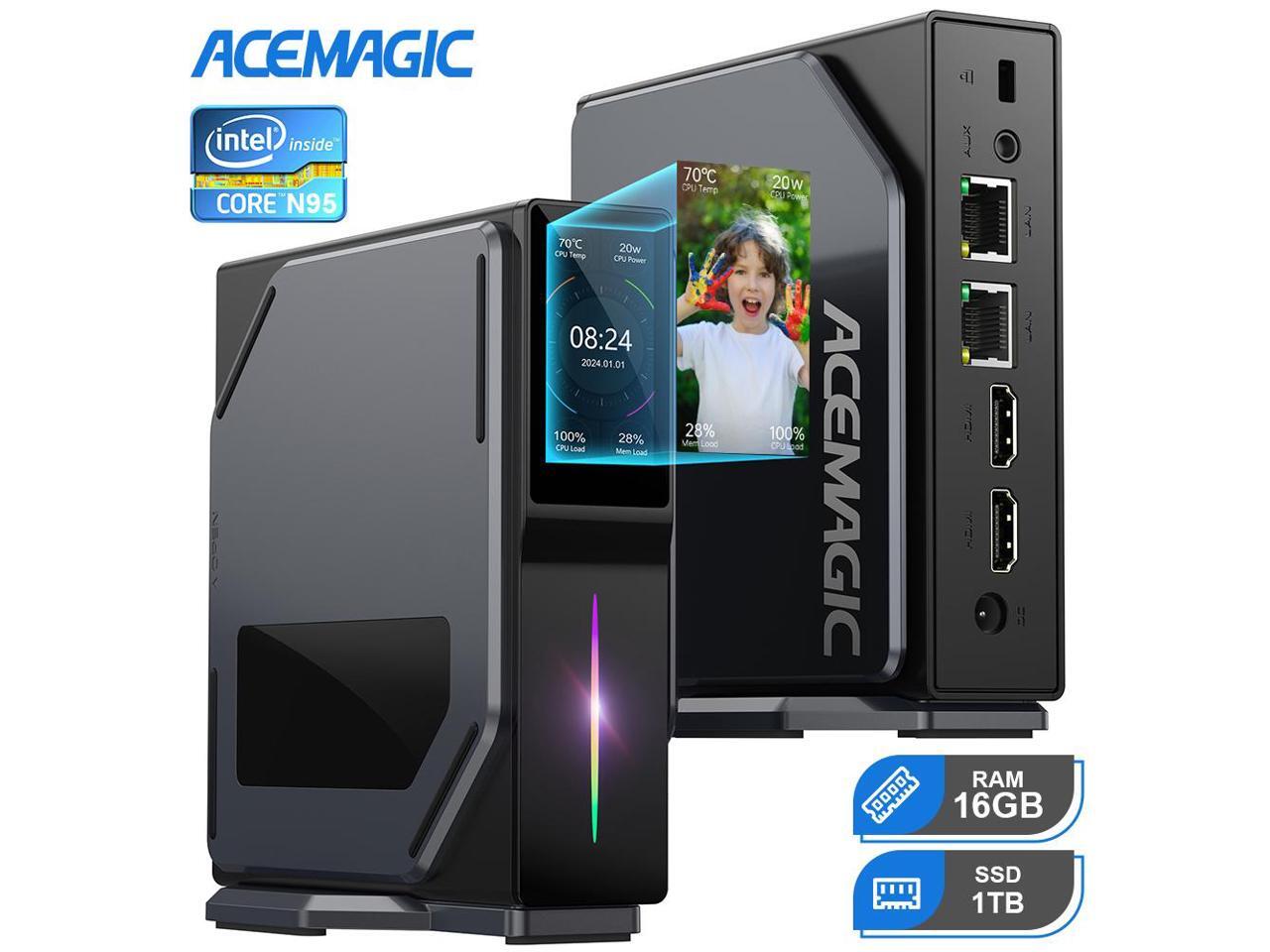
The S1 is AceMagic’s experiment in making a sub-$250 mini PC visually interesting. Most N95 mini PCs are anonymous black plastic squares. The S1 is a small vertical tower (roughly 165 mm tall) with a 1.9-inch full-color TFT LCD on the front face that displays CPU temperature, fan speed, memory load, current power draw, and the time, with four built-in themes and a desktop utility for loading personal photos as a custom background. There’s also an RGB light strip running down one side, and a magnetic side panel that pops off without tools to access the RAM and SSD bays.
Inside is an Intel N95: Alder Lake-N, four cores, four threads, 3.4 GHz boost, 6 MB cache, 20 W TDP. AceMagic also sells N97 (3.6 GHz) and N100 (3.4 GHz, 6 W TDP) variants of the same chassis. The base review configuration is 16 GB of DDR4 plus a 512 GB SSD, with 1 TB and 2× M.2 storage options up the SKU stack.
What it’s good for
Home office and basic productivity. Reviewers consistently land here. NotebookCheck, TechRadar, The Gadgeteer, and TweakTown all describe the S1 as “perfectly capable” for Office, browser-tab work, video conferencing, email, and 1080p YouTube/Netflix playback. The N95 is not fast, but it’s adequate, and the 16 GB of RAM means it doesn’t choke under modest multitasking the way 8 GB N100 boxes do.
HTPC and 4K media playback. Two HDMI 2.0 outputs, full 4K@60Hz, and Intel’s media engine handles HEVC and AV1 decode in hardware. The vertical tower fits cleanly behind or beside a TV, and the front LCD doubles as a clock or photo frame in this role.
Home-lab / small-NAS / dual-NIC sandbox. This is the S1’s quietly distinguishing feature. Two Gigabit Ethernet ports plus dual M.2 storage make this a credible little OPNsense / pfSense / Proxmox box, a small TrueNAS Scale node, or a home-server learning environment for under $250. The 20-watt TDP keeps idle power draw very low, which matters for a 24/7 box.
Build and connectivity
The vertical tower is plastic, the magnetic side panel is the same well-engineered mechanism as on the AceMagic AD08, and the included stand is fixed via a magnetic connector, meaning the unit can be placed vertically or horizontally with a quick flip. The 1.9-inch LCD is connected to a small internal USB controller and configured via an AceMagic Windows utility; reviewers note the customization works as advertised, including arbitrary background images and theme order. The RGB strip is controllable from the same utility.
Port layout:
- 2× USB 3.2 Gen 1 Type-A (5 Gbps)
- 2× USB 2.0 Type-A (480 Mbps; older standard, present for keyboard/mouse use)
- 2× HDMI 2.0 (4K@60Hz each)
- 2× Gigabit Ethernet (dual NIC)
- 3.5 mm combo audio
- DC power input
Wi-Fi 6 (802.11ax) and Bluetooth 5.2 on current 2025-2026 revisions; older S1 batches shipped with Wi-Fi 5 / BT 4.2, so verify the listing carefully. There is no USB-C, no DisplayPort, no SD card reader, and the USB 2.0 ports are a real generation behind what the rest of the market ships in 2026.
Memory, storage, and upgrades
The S1 uses a single SO-DIMM slot (not dual-channel) for DDR4, meaning memory bandwidth is limited compared to a 2×8 GB configuration on the same chip. That is a known constraint of the Alder Lake-N platform, not a chassis decision. RAM is upgradable to 32 GB (a single 32 GB SO-DIMM works, per multiple reviewer reports).
Storage is the S1’s other quiet strength: a primary M.2 2280 NVMe slot (PCIe Gen 3 x2) plus a secondary M.2 SATA SSD bay. With both slots populated, you can run a 1 TB NVMe boot drive and a 2 TB SATA SSD for cheap mass storage in the same chassis, a configuration that most $400 mini PCs don’t offer.
Pricing and where to buy
As of April 2026:
- N95, 16 GB / 512 GB: $239–$269 on Amazon and AceMagic direct
- N95, 16 GB / 1 TB: $269–$309
- N100 variant, 16 GB / 512 GB: $249–$289
- N97 variant: similar to N95 pricing
The N95 and N100 perform within a few percentage points of each other for most workloads; the N100 has lower TDP (6 W) and slightly better efficiency, the N95 has slightly higher peak frequency. For a desk PC, the difference is invisible; for a fanless / 24-7 NAS role, the N100 is the better pick. Related: the 10 best mini PCs under $500 on Amazon.
What we’d flag
- Single-channel memory is a real performance ceiling. iGPU-bound workloads (light gaming, GPU compute) lose 20–30% versus dual-channel platforms.
- Two USB 2.0 ports in 2026 is a cost cut showing through. They work for keyboard/mouse but are slow for any storage or peripheral that matters.
- No USB-C, no DisplayPort, no Thunderbolt. Not surprising at this price, but worth knowing.
- N95 is a budget chip. Anything CPU-heavy (software compilation, video transcoding without quicksync, modern AAA gaming, large-model AI inference) is out of scope. If you wanted modern AAA gaming, the AceMagic AM18 is AceMagic’s answer.
- AceMagic 2024 malware incident applies brand-wide. Wipe the drive and reinstall Windows from a clean Microsoft ISO before first boot. Not optional.
- 1-year warranty vs. 2–3 years from larger competitors.
Verdict
The S1 is the rare budget mini PC that has a clear personality: the front LCD is genuinely fun, the dual NIC and dual M.2 storage make it a credible home-lab platform, and the vertical tower form factor is a refreshing change from the standard slab. At $239–$309 it’s priced well for what it is. Buy it for an HTPC, a small home server, a low-power desktop for a guest room or a kid’s homework machine. Do not buy it as your primary workstation, and do not buy it for any kind of gaming. And as with every AceMagic in 2026, wipe Windows clean before you boot it.