
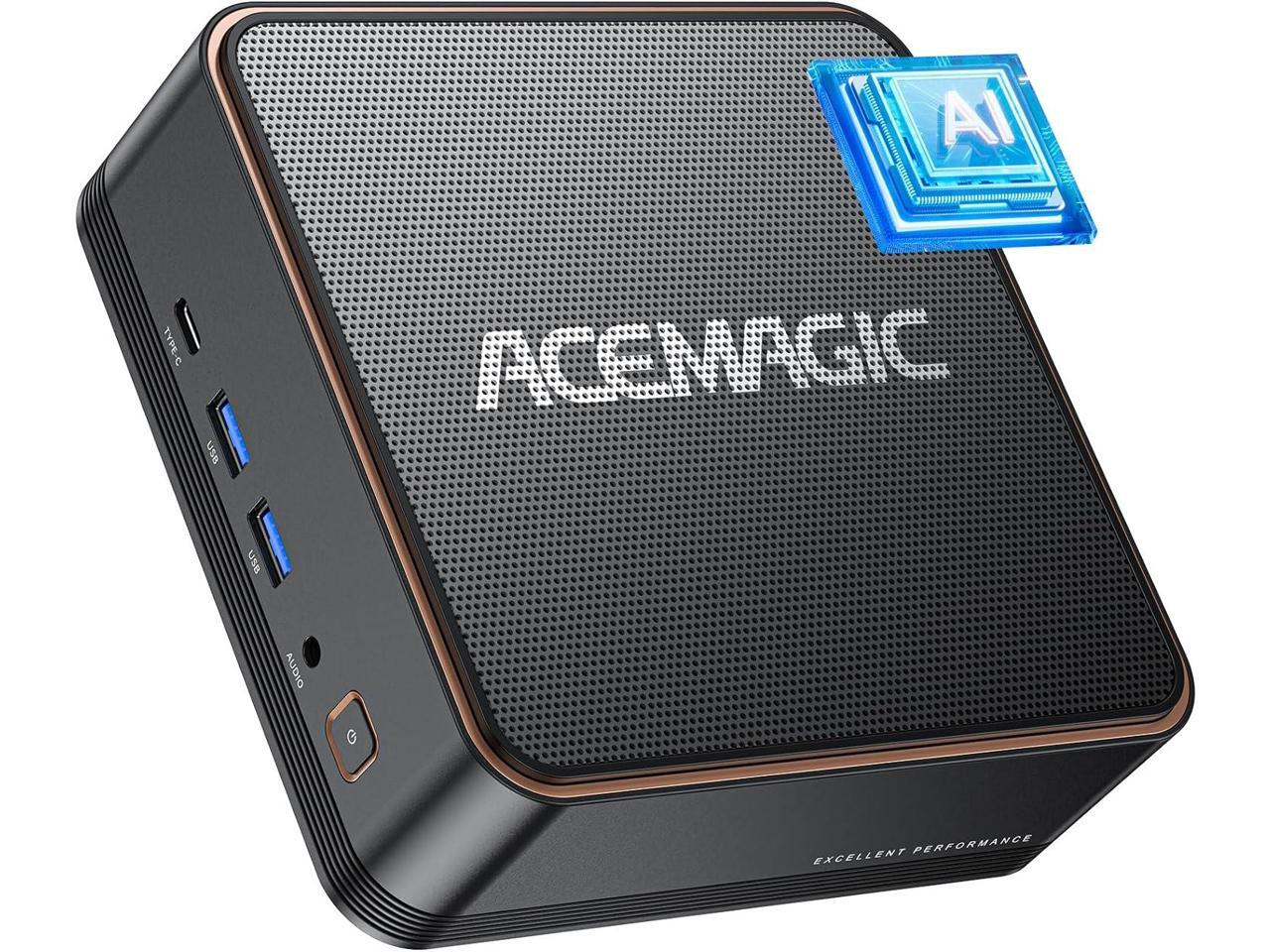
What the AceMagic F2A is
The F2A is AceMagic’s first mini PC built on Intel’s Meteor Lake (Core Ultra “1st Gen”) platform, the architecture that introduced disaggregated tile design and the on-die NPU that Intel calls AI Boost. Two configurations ship: a Core Ultra 5 125H (14 cores: 4P + 8E + 2 LPE, 18 threads, 4.5 GHz turbo, Arc 7 Xe-core iGPU) and a Core Ultra 7 155H (16 cores, 22 threads, 4.8 GHz, Arc 8 Xe-core iGPU). Both run at a 65-watt sustained TDP, meaningfully higher than the 28-watt default these chips ship in laptops, which is where the F2A finds most of its performance headroom.
It is also AceMagic’s most modern mini PC for connectivity: Wi-Fi 7 via Intel’s BE200 module, Bluetooth 5.4, 2.5 GbE Ethernet, and dual HDMI 2.1 with 8K@60Hz output. The chassis is a small mesh-topped box with the AceMagic wordmark on the lid, closer in feel to a Beelink or Geekom than to the gamer-aesthetic AD08.
What it’s good for
Office work and creator workflows. This is the F2A at its best. The Ultra 5 125H benchmarks just below the i5-12450H in single-thread but pulls ahead in multi-thread thanks to the LPE cores and the new architecture. Reviewers consistently land on “very capable” for Office plus browser plus video conferencing plus light Lightroom / Photoshop / Premiere at 1080p editing. The Ultra 7 155H configuration adds enough multi-threaded headroom to make it a real DaVinci Resolve / 4K-edit machine for short-form content.
On-device AI. This is the platform’s signature feature. The integrated AI Boost NPU delivers approximately 10–11 TOPS, useful for Windows Studio Effects, the local-mode side of Adobe’s AI features, Whisper-class speech recognition, and the inference layer of consumer creator apps. It is not a Copilot+ machine (Microsoft set the bar at 40 TOPS), but it is genuinely useful for the current generation of AI-accelerated productivity software.
Light gaming. Intel Arc Graphics with 7 or 8 Xe cores at 2.2 GHz lands in the same neighborhood as a Radeon 780M for esports titles and 1080p Low/Medium AAA gaming: Cyberpunk 2077 around 35–45 fps at 1080p Low, esports above 100 fps. AnandTech’s tests showed Arc holding up well against the AMD competition for synthetic workloads, with driver maturity still uneven on certain older titles.
Build and connectivity
The chassis is a 130 × 130 × 60 mm aluminum-bottom, mesh-top box with rubber feet. The mesh on the lid is functional: dual fans (a 100 × 15 mm centrifugal CPU fan and a 40 × 7 mm secondary fan) pull air through the top, exhausting out the rear and sides. The fan tuning is the F2A’s most-flagged complaint: Tom’s Guide called it “one annoying flaw,” and Liliputing said the same. The fans are audible at idle and clearly present under sustained load; there is no software panel to slow them down.
Port layout:
- 2× HDMI 2.1 (8K@60Hz, 4K@120Hz)
- 1× USB-C 3.2 Gen 2 with DP 1.4 alt-mode (rear)
- 1× USB-C 3.2 Gen 2 (front)
- 2× USB-A 3.2 Gen 2 (rear, 10 Gbps)
- 2× USB-A 3.2 Gen 1 (front, 5 Gbps)
- 1× 2.5 GbE Ethernet
- 3.5 mm combo audio
The conspicuous omission, given that this is a Meteor Lake platform with full Thunderbolt 4 support on the silicon, is that AceMagic does not wire up Thunderbolt or USB4 on the F2A. Liliputing flagged this directly. For a mini PC that costs $500–$650, in 2026, with hardware that natively supports it, the omission is hard to defend. If you intended to plug an eGPU or a Thunderbolt dock into this machine, you can’t.
Memory, storage, and upgrades
32 GB of DDR5-5600 in dual channel (2 × 16 GB SO-DIMM), upgradable to 96 GB. One M.2 2280 PCIe Gen 4 NVMe slot with a 1 TB stock SSD. Bottom-panel access via a single set of screws: no magnetic panel, but straightforward to open. AceMagic includes a small Phillips driver in the box.
This is meaningful generational progress over the AD08 / AD15: DDR5 instead of DDR4, PCIe Gen 4 instead of Gen 3, and a stock SSD that reviewers describe as adequate (a Kingston OEM PCIe 4.0 unit on most current SKUs) rather than the SATA-class disappointment of the AD15.
Pricing and where to buy
Configurations as of April 2026:
- Ultra 5 125H, 32 GB / 1 TB: $455–$499 on Amazon (frequent slick-deal pricing)
- Ultra 7 155H, 32 GB / 1 TB: $549–$649 on Amazon and AceMagic direct
- Barebone (no RAM/SSD): ~$399 on AceMagic’s store
The 1-year warranty applies across all SKUs. Amazon return policy is the practical buyer-protection layer; the direct AceMagic store ships from US inventory with similar lead times but no marketplace return safety net.
What we’d flag
- No Thunderbolt / USB4. The Meteor Lake silicon supports it. AceMagic chose not to wire it. This is the F2A’s single biggest hardware miss.
- Fan noise is real. Multiple reviewers flagged audibly noisy fans at idle and under load, with no software-level control. Liliputing called the result “underwhelming” given the rest of the spec.
- NPU is ~10–11 TOPS. Useful, but well short of the 40-TOPS Copilot+ threshold. If a Copilot+ branding is required, this isn’t it.
- AceMagic 2024 malware incident applies brand-wide. Wipe and reinstall Windows before first boot.
- 1-year warranty vs. 2–3 years from competitors at the same price.
Verdict
The F2A is AceMagic’s most modern Intel mini PC, and it’s a genuinely capable machine for productivity, creator workflows, on-device AI, and 1080p gaming. The Wi-Fi 7 and 2.5 GbE bring it forward into 2026 in a way the older AD-series doesn’t manage. But the missing Thunderbolt / USB4 is a hardware-level decision that limits the platform’s ceiling, and the fan tuning means this is not a machine you put on your desk for quiet work. Buy it as an Ultra 5 at $455 if the noise and the missing Thunderbolt don’t bother you. If they do, the Geekom A8 Max or a Beelink SER8 are the comparison points.