
What it is
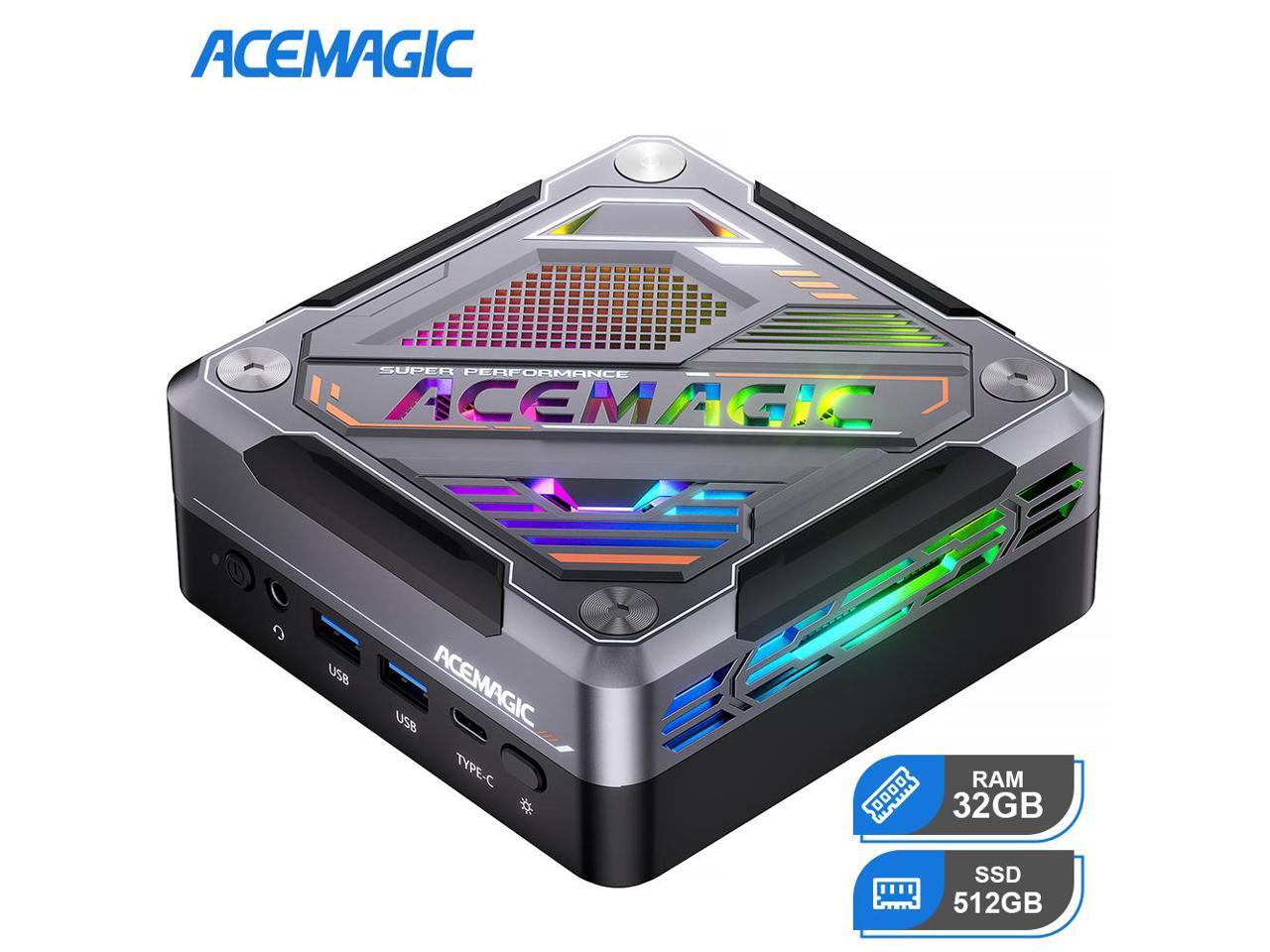
The AM18 is the most ambitious mini PC AceMagic has shipped to date. Inside an angular full-metal chassis with multi-zone RGB lighting and a 90 mm top-mounted fan sits an AMD Ryzen 7 7840HS: Zen 4, 8 cores, 16 threads, 5.1 GHz turbo, 16 MB of L3 cache, and AMD’s Radeon 780M integrated GPU (RDNA 3, 12 compute units at 2.7 GHz). Memory is 32 GB of DDR5-5600 in dual channel, storage is a 1 TB PCIe Gen 4 NVMe SSD on most current SKUs, and connectivity finally includes the port that the F2A doesn’t have: a real USB4 at 40 Gbps.
It is, in short, the AceMagic that catches up to Geekom’s A8 Max and Beelink’s SER8 on hardware, with an aesthetic that some reviewers have politely called “cyberpunk” and others have less politely called “a Decepticon helmet.”
What it’s good for
1080p gaming. This is the AM18’s signature use case, and it delivers. The Radeon 780M at the AM18’s 65 W sustained TDP runs Cyberpunk 2077 at 1080p Medium around 50–55 fps, Hogwarts Legacy at 1080p Medium around 45 fps, and esports titles (Valorant, CS2, Rocket League, Overwatch 2) above 100 fps consistently. Multiple reviewers describe the gaming experience as “outstanding for an integrated-GPU box.” It is not a 4K gaming machine, and it is not going to run Path Tracing, but for 1080p it is a perfectly credible alternative to a $700–$900 entry-level gaming desktop.
Creator workflows. Eight Zen 4 cores plus 32 GB of dual-channel DDR5-5600 plus a PCIe Gen 4 NVMe SSD makes the AM18 a real Lightroom / Photoshop / Premiere 1080p / DaVinci Resolve machine. 4K editing is feasible but not full-time work. The 7840HS also includes AMD’s Ryzen AI XDNA NPU at approximately 10 TOPS, the same generation of NPU as the Intel Core Ultra 7 155H, useful for the same class of consumer creator AI features.
On-device AI experimentation. The Radeon 780M handles 7B-class language models cleanly via Ollama / LM Studio, and the XDNA NPU is starting to see software support in 2026 for Whisper-class speech recognition and small image-generation pipelines. It is not a dedicated-GPU AI workstation (that’s still an RTX 4060 / 4070 territory), but for a 1.4-liter box at this price it is a credible sandbox.
Home and office work. All of the above doesn’t preclude the AM18 from being a productivity desktop. With the RGB turned off (which the BIOS allows), it is just a fast, quiet desktop. The 90 mm top fan keeps the chip cool enough that fan noise under sustained CPU load is in the 35-40 dBA range: present but not loud.
Build and connectivity
The chassis is full metal: aluminum top and side panels, plastic accent strips that house the RGB. The 90 mm top fan is genuinely uncommon in this size class; most mini PCs use a small blower. Reviewers credit it with keeping the 7840HS comfortably below 90 °C even at sustained 65 W loads, which is a meaningful thermal advantage.
Port layout (and this is where the AM18 separates itself from the rest of AceMagic’s lineup):
- 1× USB4 (40 Gbps): handles eGPU, Thunderbolt-class docks, 8K@60Hz displays
- 2× USB 3.2 Gen 2x2 (20 Gbps)
- 2× USB 2.0 (a curious cost cut at this price tier, likely for the included keyboard / mouse)
- 1× HDMI 2.1, 2× DisplayPort 2.0 (8K@60Hz)
- 1× 2.5 GbE Ethernet
- 3.5 mm combo audio
Wi-Fi 6 plus Bluetooth 5.2. No Wi-Fi 6E or 7, which is a step back from the F2A and a real omission at $549+. There is also no second 2.5 GbE port for dual-NIC use cases. For that, look to the S1 instead.
Memory, storage, and upgrades
32 GB of DDR5-5600 across two SO-DIMM slots, upgradable to 64 GB. One M.2 2280 PCIe 4.0 NVMe slot ships populated with a 1 TB OEM drive (Kingston OEM on most current units, per teardown reports). The chassis includes a second M.2 expansion slot, configured as either PCIe Gen 4 or SATA depending on revision. Bottom-panel access via four screws: straightforward, no magnetic mechanism here.
The dual-channel DDR5-5600 memory is the AM18’s quiet performance multiplier. On the Radeon 780M, dual-channel high-frequency DDR5 is the difference between “playable” and “unplayable” 1080p gaming, and AceMagic gets the configuration right.
Pricing and where to buy
As of April 2026:
- 32 GB / 512 GB on Amazon US: $549–$599
- 32 GB / 1 TB on Amazon US: $629–$679
- 32 GB / 2 TB direct from AceMagic: $729–$779
A newer AceMagic AM18 Pro variant with the Ryzen 7 8845HS (Zen 4 refresh, slightly higher clocks, same Radeon 780M, NPU bumped to 16 TOPS) is also shipping in 2026 at $50-$100 over the standard 7840HS pricing. If the budget allows, the 8845HS variant is the more future-proof buy.
What we’d flag
- Two USB 2.0 ports at this price tier is genuinely surprising. They are functional but a generation behind.
- No Wi-Fi 6E or Wi-Fi 7. AceMagic shipped Wi-Fi 7 on the F2A; it’s puzzling that the AM18, their flagship, got Wi-Fi 6 instead.
- The aesthetic is committed. The angular cyberpunk styling and multi-zone RGB are not for every desk. The RGB can be turned off in BIOS; the chassis shape cannot.
- 1-year warranty vs. 3 years on a Geekom A8 Max at similar price.
- AceMagic 2024 malware incident applies brand-wide. Wipe the drive and reinstall Windows from a clean Microsoft ISO before first boot. This is not negotiable.
- No second NIC, no SD card reader, no front USB-C: small omissions at $600+.
AceMagic AM18 verdict
The AM18 is the AceMagic mini PC most likely to satisfy a buyer who wants a real machine: fast Zen 4 CPU, RDNA 3 iGPU that genuinely games at 1080p, dual-channel DDR5, USB4, full-metal chassis, large effective fan. The aesthetic is loud, the warranty is short, and the Wi-Fi standard is a generation behind, but the underlying hardware is among the most capable in the sub-$700 mini PC class. Buy it if you want a small gaming-and-creator box and the cyberpunk look doesn’t bother you. If it does, the Geekom A8 Max is the same chip class in a quieter design, and a longer warranty.